
• Zum Hauptinhalt springen
  • Zum Footer springen
  • Deutsch - de
  • English - en

    SyNergy - Mu...

    • About
      • About us
      • Our Measures
      • Members
      • Cluster Management
      •  PhD & Postdoc representatives
      • Scientific Advisory Board
      •  International cooperation partners
      • Timeline
      •  Media Kit
      • Contact
    • News & Events
      • News
      • Events
      • In the News
      • Open Positions
    • Research
      • Publications
      • Our Research Focus
      • Technology Hubs
      • Research Spotlight
      • Research Data Management
      • Sustainability Initiative
      •  Code of Conduct
    • Science & Society
      • For Schools & Students
      • Public Events
      • Podcasts
      • Videos
    • Support for Diversity & Equity
      • Newcomer Center
      • Gender Equality Program
      • Early Career Investigator Program
    1. Home
    2. News & Events
    3. News
    4. Using organoids to learn about autism
    News | 22/05/2023 | Press Release
    A NEW LOOK AT THE BRAIN’S IMMUNE SYSTEM

    Using organoids to learn about autism

    Microglia cells, which play a major role in the immune system of the brain, are difficult to study. Researchers have now succeeded in modelling the development of the brain and its immune system using organoids. With these miniature models of groups of brain cells, they have investigated changes associated with a certain type of autism spectrum disorder. This approach can also be used to study other conditions.
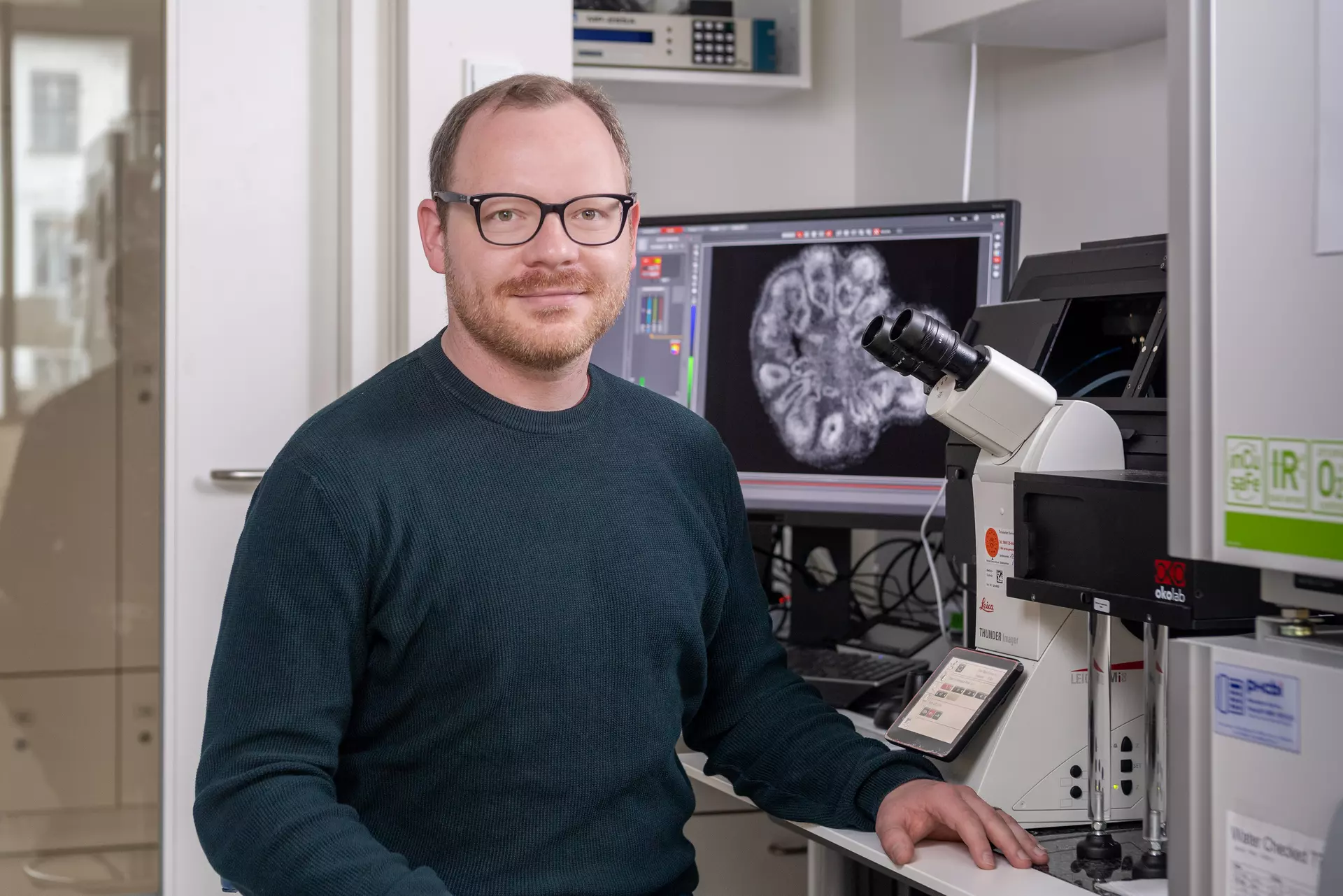
     Simon Schäfer in his lab in front of a microscope
    Andreas Heddergott / TUM
    Simon Schäfer, Professor for Advanced Organoid Technologies for Mental Health Research (TUM)

    In the brain, microglia perform such functions as engulfing damaged nerve cells and removing the debris. They can also promote the growth of neurons. As a result, they play an important role in the development of the brain and in diseases of the nervous system.

    Until now, many aspects of how microglia function have remained unknown. This is partly because their behavior under laboratory conditions is fundamentally different than in the human body. An international research team in which Simon Schäfer, Professor for Advanced Organoid Technologies for Mental Health Research at the Technical University of Munich (TUM), has made decisive contributions, describes an approach to this problem in the journal Cell.

    Links

    • Press Release TUM (English)
    • Press Release TUM (German)

    Participating Universities
     LMU logo in white
     TUM logo in white
    Partner Institutions
     Logo DZNE in white
    Helmholtz Munich logo in white 
     Logo Max Planck Gesellschaft 

    SyNergy is funded by the Deutsche Forschungsgemeinschaft (German Research Foundation) within the framework of the German Excellence Strategy (EXC 2145 SyNergy – ID 390857198). The Excellence Strategy promotes outstanding research at German universities. 

    Contact

    Munich Cluster for Systems Neurology (SyNergy)

    Feodor-Lynen-Str. 17
    81377 Munich
    +49 (0)89 4400-46497
    ySüubJgybcјuipxј;hvf:ulyz-mi
    Editor login
    Imprint | Data-Safety