This is a summary of R. Dilcher, S. Wall, M. Groß et. al. (2024). Combining cerebrospinal fluid and PI-2620 tau-PET for biomarker-based stratification of Alzheimer’s disease and 4R-tauopathies. Published in Alzheimer’s & Dementia. https://doi.org/10.1002/alz.14185
The challenge
Patients regularly show up at university hospitals with diseases so rare and specific as to be scarcely known to physicians in private practice. Primary 4-repeat tauopathies are a good example. These diseases are primarily associated with movement disorders but include symptoms that often resemble those of Alzheimer’s disease, making precise diagnosis difficult. Primary 4-repeat tauopathies are currently diagnosed almost exclusively using clinical criteria – without specific biomarkers that enable conclusive diagnosis in patients. In our study, we, therefore, developed a novel biomarker algorithm.
Our approach
We cross-sectionally assessed combinations of cerebrospinal fluid measures (CSF p-tau181 and t-tau) and [18F]PI-2620 tau-PET in patients with AD (n=64), clinically suspected 4R-tauopathies (PSP or CBS, n=82) and healthy controls (n=19).
Our findings
Our study revealed that tau in primary 4-repeat-tauopathies can be detected with the novel tau-PET tracer, but unlike in Alzheimer’s, it appears in unique subcortical brain regions while cerebrospinal fluid biomarker levels remain normal. Additionally, we found new biomarkers that indicate the presence of a 4-repeat tauopathy. Diagnosis gets really effective when we analyze a combination of cerebrospinal fluid test, innovative biomarkers, and PET signal in the subcortical regions. This allows us to recognize a 4-repeat tauopathy with high certainty.
Implications
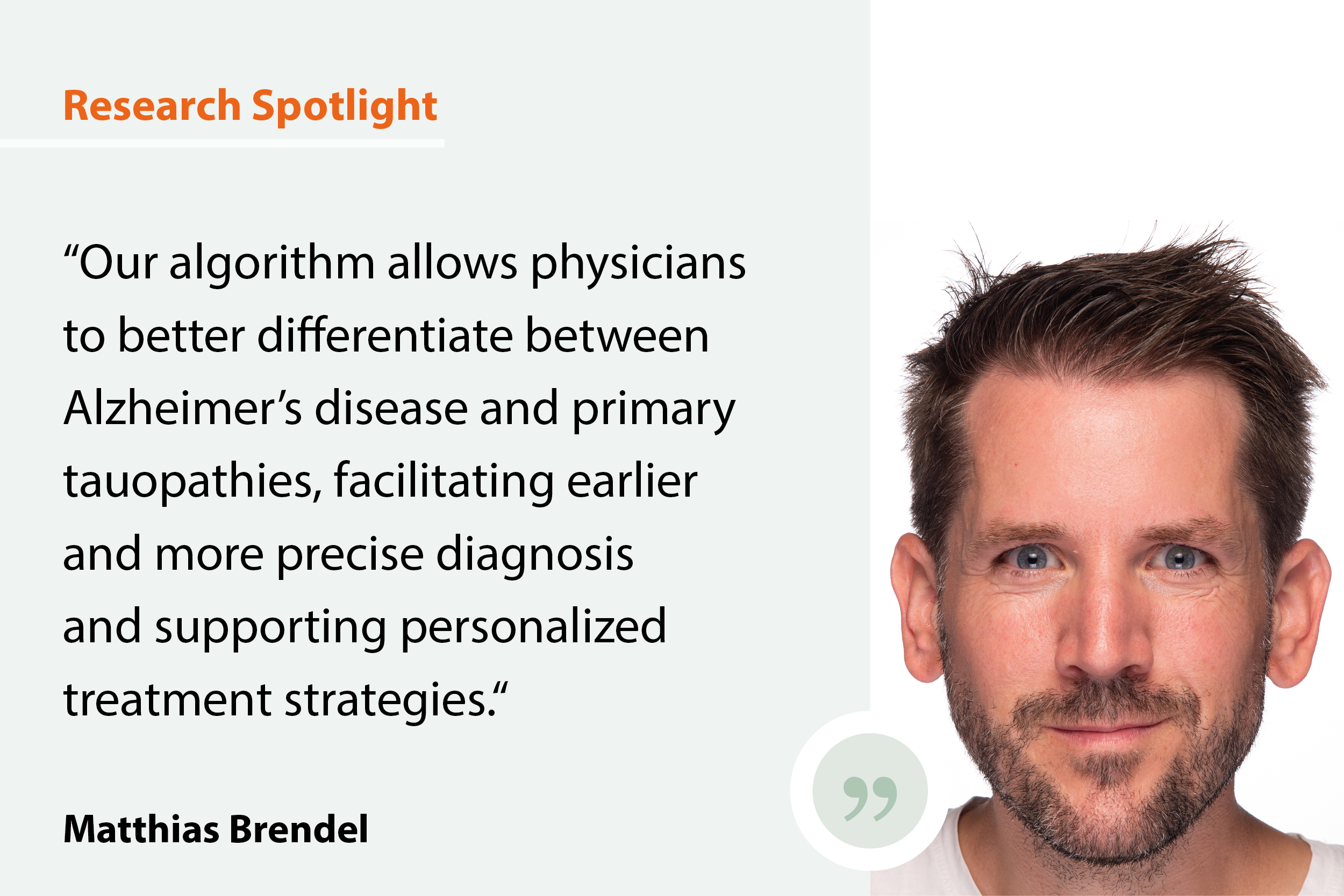
The new diagnostic workflow allows for more precise differentiation between Alzheimer’s disease and primary 4-repeat-tauopathies, facilitating earlier and more accurate diagnoses and supporting personalized treatment strategies – integrating neuronal injury biomarkers, such as [18F]PI-2620-PET-assessed blood flow, increases diagnostic efficiency and minimizes radiation exposure. Implementing the new biomarker algorithm in clinical trials marks a significant advancement, accelerating the development of disease-modifying therapies for both Alzheimer’s disease and primary 4-repeat-tauopathies.
Creating SyNergies
SyNergy members Matthias Brendel and Nicolai Franzmeier combined their imaging expertise in this study with the clinical expertise of Günter Höglinger, Johannes Levin and Robert Perneczky.