• Zum Hauptinhalt springen
  • Zum Footer springen
  • Deutsch - de
  • English - en

    SyNergy - Mu...

    • About
      • About us
      • Our Measures
      • Members
      • Cluster Management
      •  PhD & Postdoc representatives
      • Scientific Advisory Board
      •  International cooperation partners
      • Timeline
      •  Media Kit
      • Contact
    • News & Events
      • News
      • Events
      • In the News
      • Open Positions
    • Research
      • Publications
      • Our Research Focus
      • Technology Hubs
      • Research Spotlight
      • Research Data Management
      • Sustainability Initiative
      •  Code of Conduct
    • Science & Society
      • For Schools & Students
      • Public Events
      • Podcasts
      • Videos
    • Support for Diversity & Equity
      • Newcomer Center
      • Gender Equality Program
      • Early Career Investigator Program
    1. Home
    2. News & Events
    3. News
    4. Gloria Biechele receives Best Dissertation Award from the Munich Medical Research School
    News | 27/07/2023 | Award

    Gloria Biechele receives Best Dissertation Award from the Munich Medical Research School

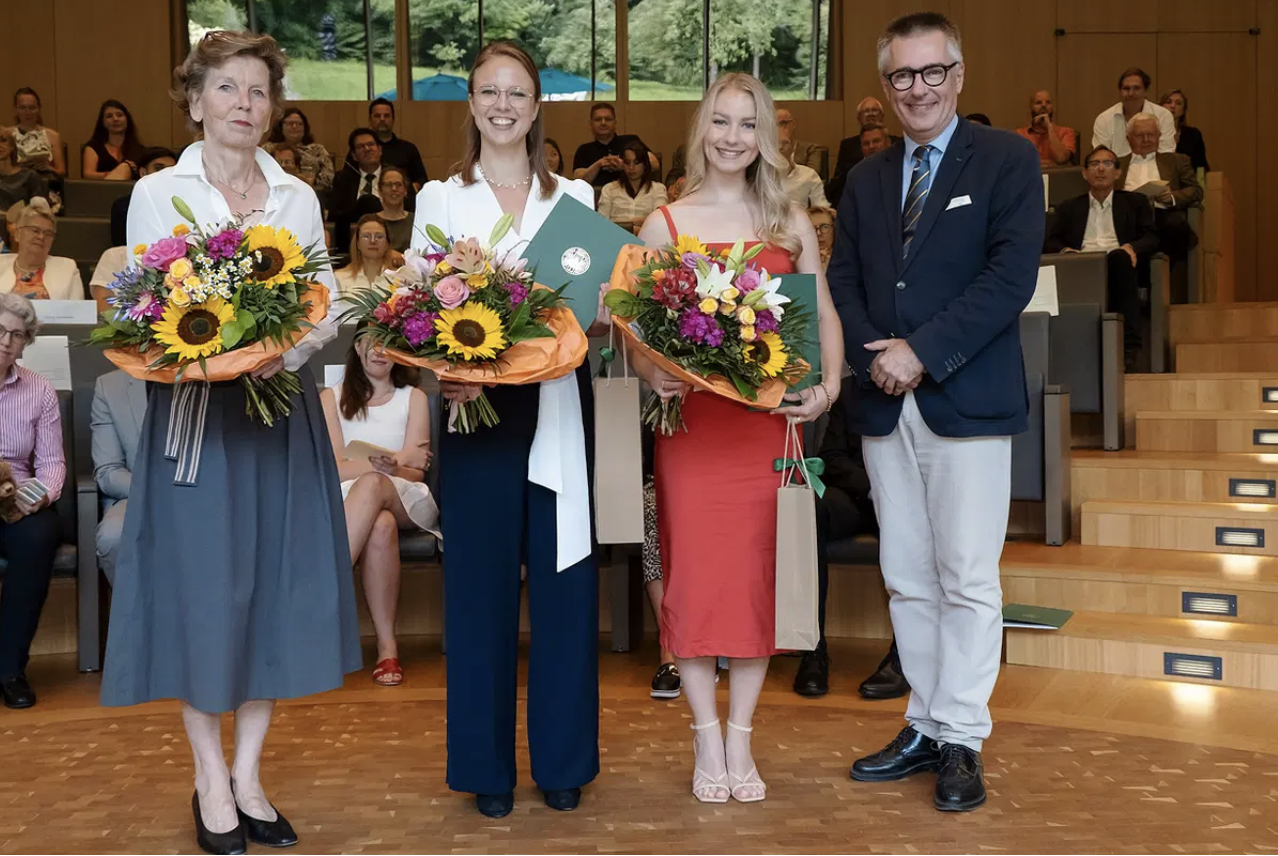
    On July 22 Gloria Biechele received an award for her Dissertation that she has written under the supervision of Matthias Brendel: the Dr. Hildegard and Heinrich Fuchs Preis. Her dissertation on immunomodulatory therapies for Alzheimer’s Disease in mouse models was selected from over 600 dissertations.
     Gloria Biechele holding flowers and award
    LMU Klinikum
    Dr. Astrid Reinke (Vorsitzende Dr. Hildegard und Heinrich Fuchs Stiftung), Dr. Charlotte Blessing, Dr. Gloria Biechele, Prof. Dr. Nikolaus Plesnila (Laudator). 

    In her dissertation, entitled “In Vivo Monitoring der Neuroinflammation während einer Immunmodulatorischen Therapie in Mausmodellen der Amyloid Pathologie“, she tested PET monitoring to determine the optimal therapy allocation as well as to evaluate the response to treatment. The first study concerned the drug Pioglitazone – she found that the drug attenuated microglial activation and improved cognitive performance, especially within female mice with high inflammation levels prior to therapy. The second study focused on amyloid – surprisingly, she found that an increase of amyloid during the immunomodulatory treatment was linked to improved cognitive performance. The molecular origin was found to be a rescue of dendritic spine density in the hippocampal cornu ammonis.

    Her research suggests that a denser form of amyloid plaques may actually improve cognitive performance by reducing neurotoxicity, therewith protecting brain integrity. Increasing amyloid PET signaling during immunomodulatory therapy can therefore be beneficial.

    Her dissertation (in German): https://edoc.ub.uni-muenchen.de/31225/1/Biechele_Gloria.pdf

    Participating Universities
     LMU logo in white
     TUM logo in white
    Partner Institutions
     Logo DZNE in white
    Helmholtz Munich logo in white 
     Logo Max Planck Gesellschaft 

    SyNergy is funded by the Deutsche Forschungsgemeinschaft (German Research Foundation) within the framework of the German Excellence Strategy (EXC 2145 SyNergy – ID 390857198). The Excellence Strategy promotes outstanding research at German universities. 

    Contact

    Munich Cluster for Systems Neurology (SyNergy)

    Feodor-Lynen-Str. 17
    81377 Munich
    +49 (0)89 4400-46497
    yüubgybcјuipxј+,vfulayzn mdi
    Editor login
    Imprint | Data-Safety