• Zum Hauptinhalt springen
  • Zum Footer springen
  • Deutsch - de
  • English - en

    SyNergy - Mu...

    • About
      • About us
      • Our Measures
      • Members
      • Cluster Management
      •  PhD & Postdoc representatives
      • Scientific Advisory Board
      •  International cooperation partners
      • Timeline
      •  Media Kit
      • Contact
    • News & Events
      • News
      • Events
      • In the News
      • Open Positions
    • Research
      • Publications
      • Our Research Focus
      • Technology Hubs
      • Research Spotlight
      • Research Data Management
      • Sustainability Initiative
      •  Code of Conduct
    • Science & Society
      • For Schools & Students
      • Public Events
      • Podcasts
      • Videos
    • Support for Diversity & Equity
      • Newcomer Center
      • Gender Equality Program
      • Early Career Investigator Program
    1. Home
    2. News & Events
    3. News
    4. Zebrafish compass neurons learn visual anchoring
    News | 06/02/2026 | Research Spotlight

    Zebrafish compass neurons learn visual anchoring

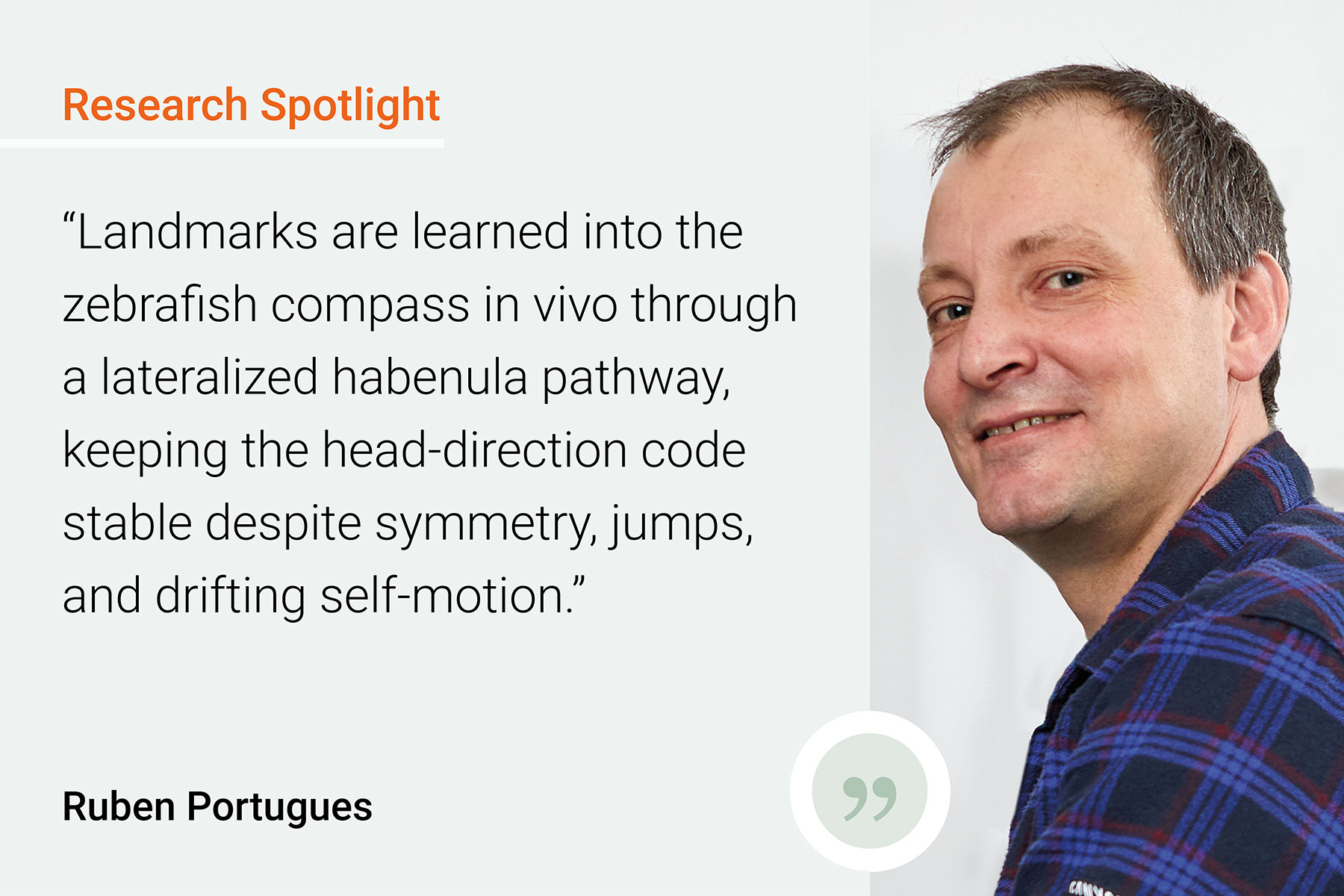
    Using panoramic virtual reality and two-photon imaging, we show that larval zebrafish head-direction neurons track complex visual scenes. They use both landmarks and optic flow, and the landmark-to-heading mapping is individually tuned and shaped by experience. A lateralized habenula-to-interpeduncular projection is required for stable landmark anchoring, pointing to Hebbian-like learning in this conserved circuit.

    This is a summary of Tanaka et al. Plastic landmark anchoring in zebrafish compass neurons. Published in Nature (2026). DOI: 10.1038/s41586-025-09888-x

    The challenge

    Head-direction (HD) neurons act as an internal compass, but the signal they carry is only useful if it stays aligned with the outside world. During navigation, landmarks can reset drift, while optic flow and other self-motion cues update heading during turns. In mammals, this visual anchoring is often attributed to interactions between cortical visual regions and the HD network. Larval zebrafish, however, navigate with a tiny brain that lacks an elaborate visual telencephalon, yet they still show sophisticated visually guided behaviours. How can such a compact vertebrate circuit combine landmarks and optic flow, learn a stable landmark-to-heading mapping, and keep it flexible when visual scenes change?

    Our approach

    We combined two-photon calcium imaging of GABAergic anterior hindbrain HD cells with a panoramic, closed-loop virtual reality arena. By manipulating scenes (landmark jumps, featureless motion, symmetric landmarks) and performing unilateral laser ablations of visual habenula axons, we tested how visual cues and specific pathways shape the HD activity “bump”.

    Our findings

    HD cells reliably aligned their population activity bump to multiple scenes, with a bias toward distal cues in the upper visual field. They maintained alignment when landmarks jumped (landmark-only) and partially followed rotations in spatial noise (optic-flow-only), indicating dual visual mechanisms. Symmetric “double-sun” training induced an unexpected remapping in which 180° of visual space expanded to occupy the full 360° HD ring. Disrupting the visual habenula projection abolished landmark anchoring while leaving the bump itself detectable. This points to an underlying neuronal architecture, that of a ring attractor, as being responsible for encoding heading.

    The implications

    A conserved habenula–interpeduncular pathway can implement experience-dependent landmark anchoring of a vertebrate compass—suggesting an evolutionarily ancient solution that does not require cortical visual circuitry.

    Creating SyNergies

    This work brought together neuroengineering, optical physiology, and theory: building a compact panoramic VR system, imaging population dynamics, modelling Hebbian landmark anchoring, and using targeted laser ablation to test causality. The result illustrates how cross-disciplinary methods can expose conserved navigation principles across species and brain architectures.

    Participating Universities
     LMU logo in white
     TUM logo in white
    Partner Institutions
     Logo DZNE in white
    Helmholtz Munich logo in white 
     Logo Max Planck Gesellschaft 

    SyNergy is funded by the Deutsche Forschungsgemeinschaft (German Research Foundation) within the framework of the German Excellence Strategy (EXC 2145 SyNergy – ID 390857198). The Excellence Strategy promotes outstanding research at German universities. 

    Contact

    Munich Cluster for Systems Neurology (SyNergy)

    Feodor-Lynen-Str. 17
    81377 Munich
    +49 (0)89 4400-46497
    yüuabgybScјuipxјJhvfulyz mi
    Editor login
    Imprint | Data-Safety | Accessibility