This is a summary of Yuste-Checa, P., Carvajal, A.I., Mi, C. et al. Structural analyses define the molecular basis of clusterin chaperone function. Published in Nature Structural & Molecular Biology (2025). https://doi.org/10.1038/s41594-025-01631-4
The challenge
Proteins fulfil a wide variety of functions in cells and must be precisely folded to do so. Incorrect folding can lead to the formation of harmful aggregates – a typical characteristic of many neurodegenerative diseases, such as Alzheimer's or Parkinson's. Molecular chaperones such as clusterin, also known as apolipoprotein J, play a central role in preventing such misfolding. However, until now, there has been no detailed understanding of the molecular functioning of this versatile protein.
Our approach
We used X-ray crystallography to elucidate the three-dimensional structure of human clusterin. Knowing how the atoms are arranged in the protein helps us understand its general mode of action and chaperone function. To further understand the effects of specific parts of clusterin, we performed structure-based mutational analysis.
Our findings
We found that clusterin is composed of three different domains. Of particular interest are two disordered, hydrophobic peptide tails that give the protein its remarkable versatility. These resemble the substrate-binding regions of small heat-shock proteins that prevent protein clumping inside cells, while clusterin functions outside the cells. By performing rational mutagenesis and functional analysis, we showed that the hydrophobic tails mediate clusterin’s chaperone function in suppressing amyloid-β, tau, and α-synuclein aggregation. In conjunction with conserved surface areas, the tail segments also participate in clusterin binding to cell surface receptors and cellular uptake, and in combination with an adjacent amphipathic helix in lipoprotein particle formation.
The implications
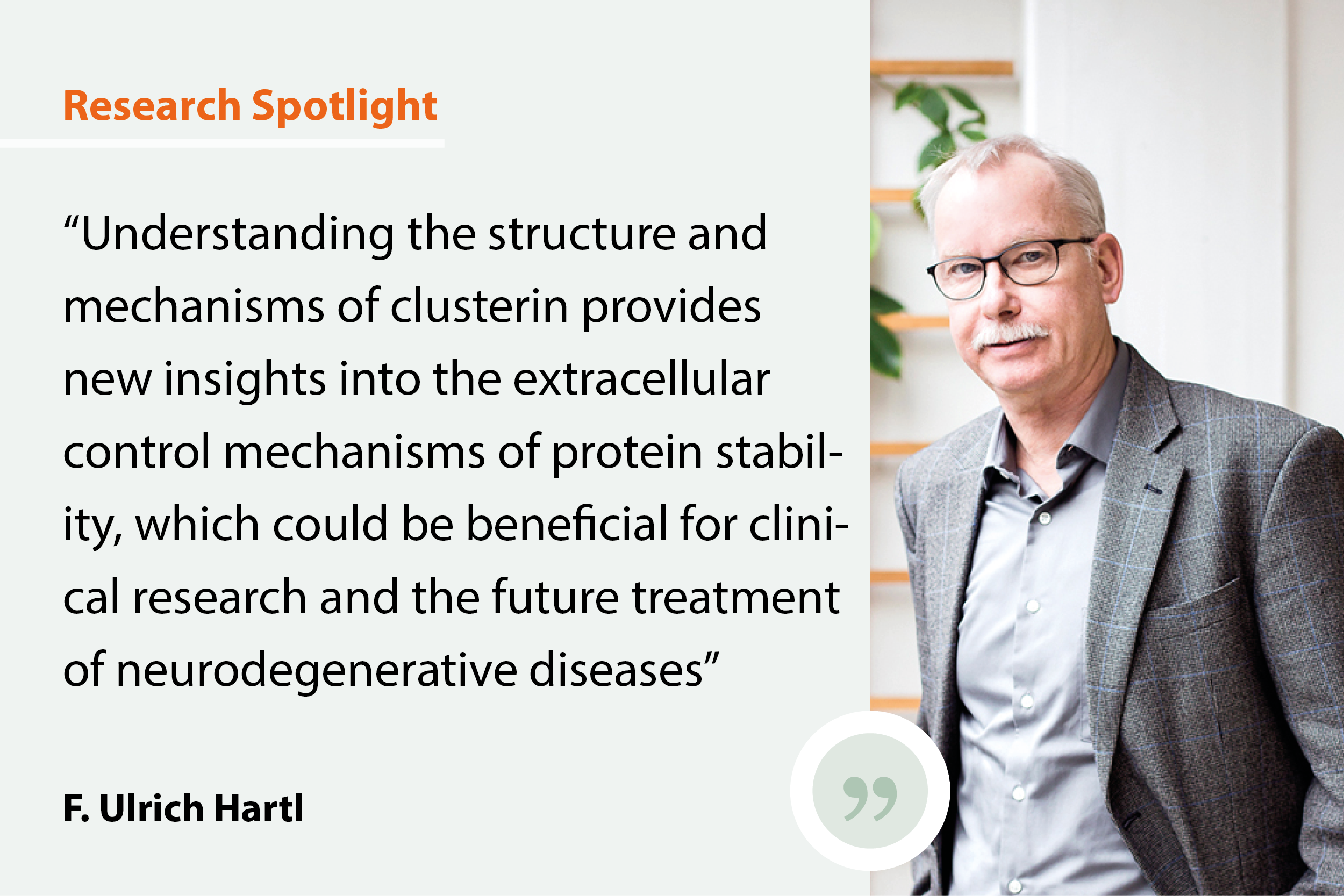
Clusterin has been shown to have several functions. For example, research indicates that clusterin binds to extracellular amyloid beta plaques, and its levels in cerebrospinal fluid are elevated in patients with Alzheimer's disease. Understanding the structure and mechanisms of clusterin provides new insights into the extracellular control mechanisms of protein stability, which could be beneficial for clinical research and the future treatment of neurodegenerative diseases.
Creating SyNergies
The study was led by our member Ulrich Hartl, the affiliated postdoc Patricia Yuste Checa, and Andreas Bracher from the Max Planck Institute of Biochemistry. It will be interesting to explore the therapeutic potential of one of the rationally designed mutants that was unexpectedly hyperactive in preventing the aggregation of the amyloid-β, in a mouse model of Alzheimer’s disease within the expertise of our SyNergy hub.