• Zum Hauptinhalt springen
  • Zum Footer springen
  • Deutsch - de
  • English - en

    SyNergy - Mu...

    • About
      • About us
      • Our Measures
      • Members
      • Cluster Management
      •  PhD & Postdoc representatives
      • Scientific Advisory Board
      •  International cooperation partners
      • Timeline
      •  Media Kit
      • Contact
    • News & Events
      • News
      • Events
      • In the News
      • Open Positions
    • Research
      • Publications
      • Our Research Focus
      • Technology Hubs
      • Research Spotlight
      • Research Data Management
      • Sustainability Initiative
      •  Code of Conduct
    • Science & Society
      • For Schools & Students
      • Public Events
      • Podcasts
      • Videos
    • Support for Diversity & Equity
      • Newcomer Center
      • Gender Equality Program
      • Early Career Investigator Program
    1. Home
    2. News & Events
    3. News
    4. New blood test shows the extent of brain injury after stroke – and reveals treatment effects
    News | 15/01/2026 | Research Spotlight

    New blood test shows the extent of brain injury after stroke – and reveals treatment effects

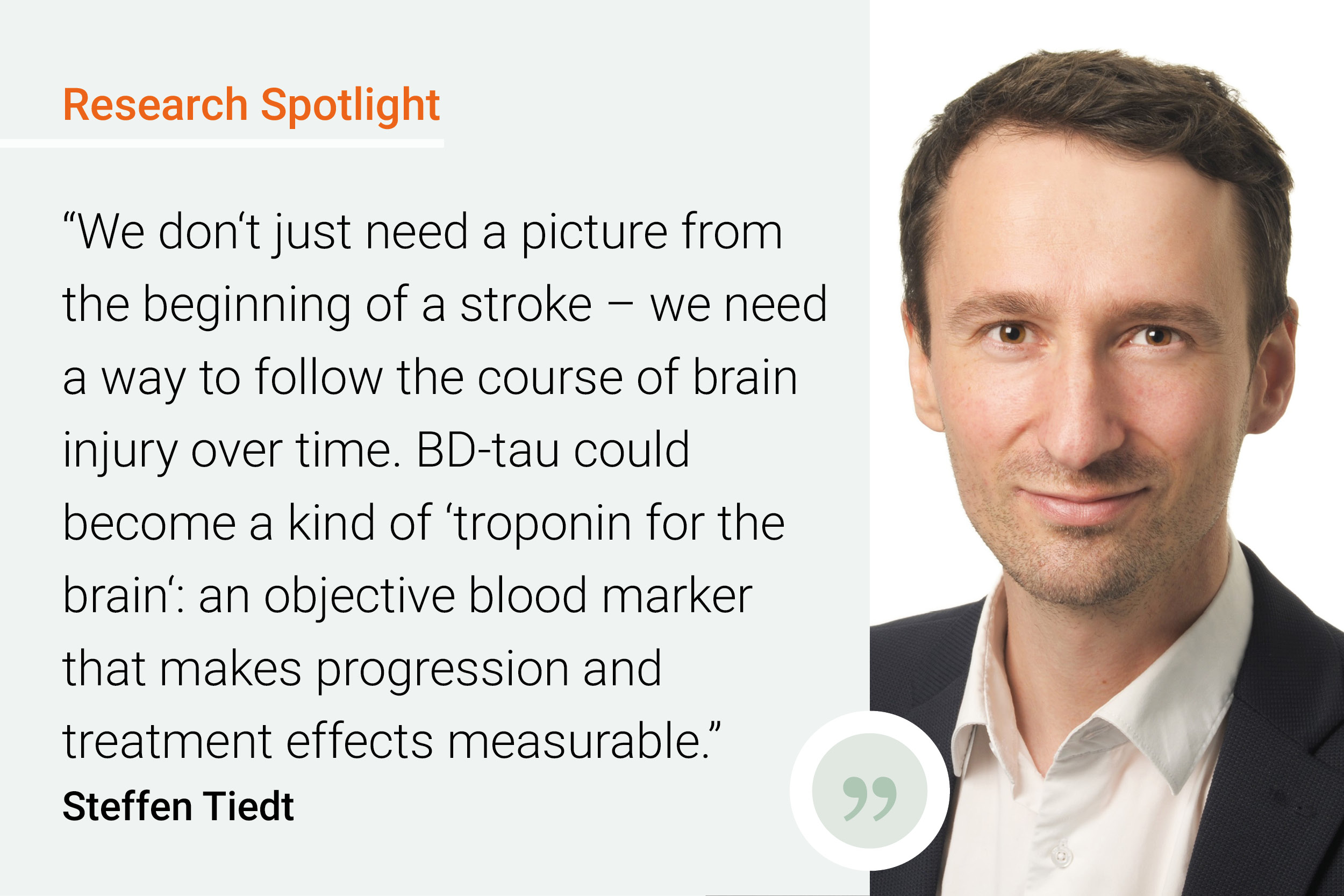
    Researchers at LMU University Hospital Munich and international partners show that the blood biomarker brain-derived tau (BD-tau) can track acute brain injury after ischemic stroke over time – something that today is typically captured only in snapshots by CT or MRI. Across three prospective studies with more than 1,200 stroke patients, BD-tau reflected the extent and progression of injury, predicted functional recovery, and even captured treatment effects after successful vessel reopening and in a phase-3 trial biomarker sub-study.

    This is a summary of Vlegels & Knuth et al. Brain-derived tau for monitoring brain injury in acute ischemic stroke. Published in
    Science Translational Medicine (2026). DOI: 10.1126/scitranslmed.adz1280


    The challenge

    In stroke care, key decisions depend on imaging – yet repeated scans are difficult, and imaging provides only intermittent snapshots of a process that can evolve rapidly over hours and days. While other organs have established blood tests to monitor acute injury, the brain still lacks a widely applicable blood-based marker that can reliably reflect ongoing brain damage and serve as a surrogate endpoint in trials.


    Our approach

    We measured plasma BD-tau with single-molecule assays in a prospective LMU cohort with serial sampling from admission to day 7 (PROMISE; n=502) and validated findings in two independent cohorts: a multicenter observational cohort (DEMDAS; n=519) and a biomarker sub-study embedded in a global, randomized phase-3 thrombectomy trial (ESCAPE-NEXT; n=193).


    Our findings

    BD-tau rose early after stroke and tracked injury burden and progression: higher early levels were associated with more extensive injury and predicted larger final infarcts, and early increases were linked to infarct growth. BD-tau continued to rise through the first week and was higher in patients with adverse secondary events. Importantly, BD-tau was a strong predictor of recovery, performing at least as well as – and in several analyses better than – other blood biomarkers and imaging metrics for predicting 90-day and longer-term functional outcome.


    The implications

    Because BD-tau reflects brain injury dynamics and detects treatment-related differences, it could become a practical tool to (i) monitor evolving injury when repeat imaging is limited, (ii) identify complications earlier, and (iii) accelerate proof-of-concept trials by providing a measurable biological readout of treatment response. The authors emphasize that next steps include defining reference ranges and clinically meaningful thresholds and enabling faster measurement (ideally point-of-care).


    Creating SyNergies

    This work brought together SyNergy expertise in clinical stroke research and systems neurology through SyNergy clinician scientists alongside the broader SyNergy, LMU and international biomarker and trial collaborations.

    Participating Universities
     LMU logo in white
     TUM logo in white
    Partner Institutions
     Logo DZNE in white
    Helmholtz Munich logo in white 
     Logo Max Planck Gesellschaft 

    SyNergy is funded by the Deutsche Forschungsgemeinschaft (German Research Foundation) within the framework of the German Excellence Strategy (EXC 2145 SyNergy – ID 390857198). The Excellence Strategy promotes outstanding research at German universities. 

    Contact

    Munich Cluster for Systems Neurology (SyNergy)

    Feodor-Lynen-Str. 17
    81377 Munich
    +49 (0)89 4400-46497
    nyüubgy:b:cјuipxWјrvfulyz-mi
    Editor login
    Imprint | Data-Safety