• Zum Hauptinhalt springen
  • Zum Footer springen
  • Deutsch - de
  • English - en

    SyNergy - Mu...

    • About
      • About us
      • Our Measures
      • Members
      • SyNergy Professorships
      • Cluster Management
      •  PhD & Postdoc representatives
      • Scientific Advisory Board
      •  International cooperation partners
      • Timeline
      •  Media Kit
      • Contact
    • News & Events
      • News
      • Events
      • In the News
      • Open Positions
    • Research
      • Publications
        • Todorov, Mihail
        • Lao, Chu Lan
        • Kopczak, Anna
        • Spitzer, Hannah
        • Groh, Janos
        • Müller, Stephan
        • Schillinger, Ulrike
      • Our Research Focus
      • Technology Hubs
      • Research Spotlight
      • Research Data Management
      • Sustainability Initiative
      •  Code of Conduct
    • Science & Society
      • For Schools & Students
      • Public Events
      • Podcasts
      • Videos
    • Support for Diversity & Equity
      • Newcomer Center
      • Gender Equality Program
      • Early Career Investigator Program
    1. Home
    2. News & Events
    3. News
    4. MouseMapper Reveals Obesity’s Whole-Body Impact
    News | 27/05/2026 | Research Spotlight

    MouseMapper Reveals Obesity’s Whole-Body Impact

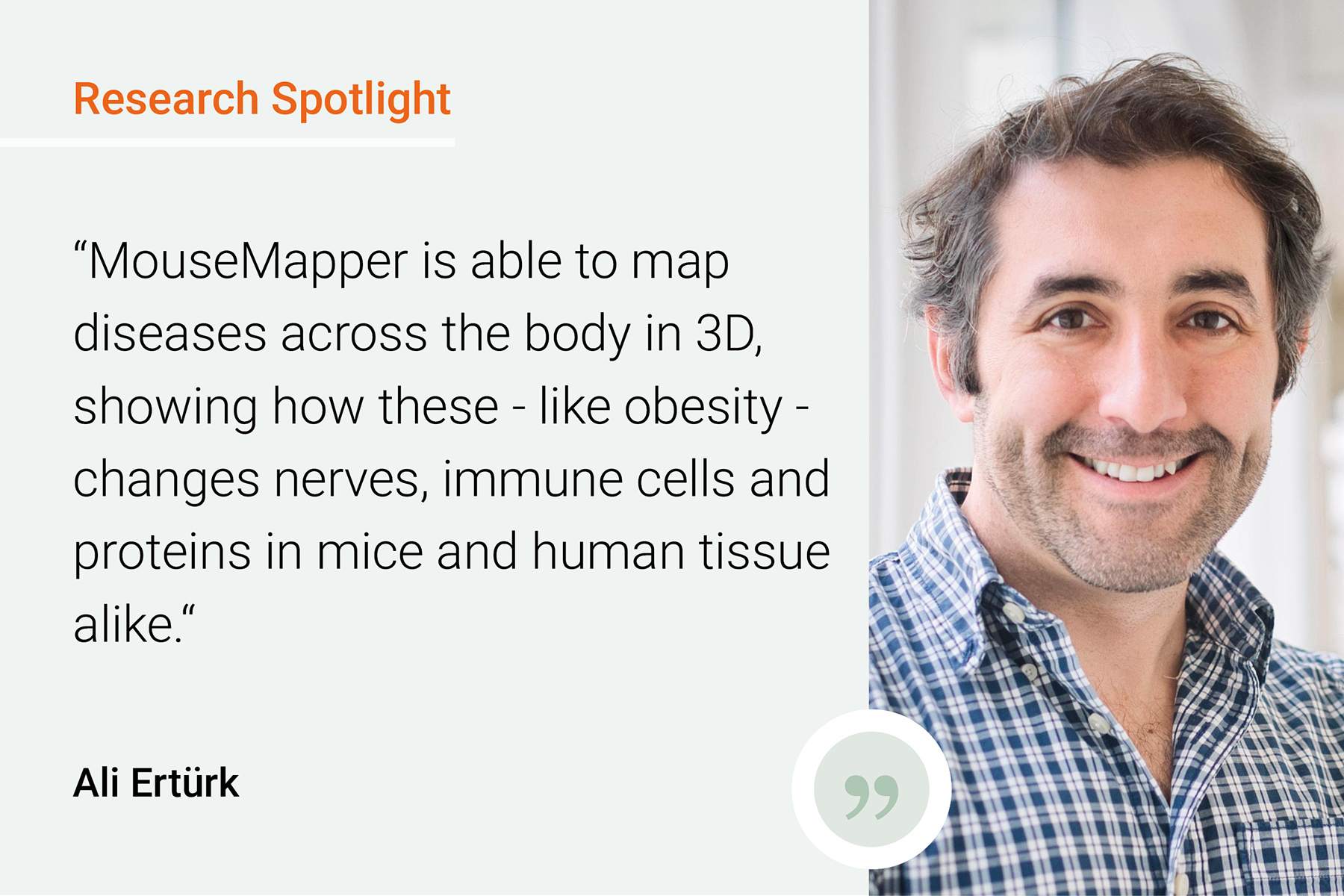
    Many diseases affect the whole body, but studying these changes at cellular resolution has remained difficult. We developed MouseMapper, a deep-learning framework that maps nerves, immune cells, organs and tissues in entire mouse bodies. Applied to obesity, MouseMapper revealed altered trigeminal nerve structure, sensory deficits and body-wide inflammatory changes linked to molecular signatures also found in human tissue.

    This is a summary of Kaltenecker et al. A deep-learning framework reveals whole-body perturbations at cell level. Published in Nature (2026). DOI: 10.1038/s41586-026-10535-2

    The challenge

    Obesity is known to affect many organs and is associated with inflammation, metabolic dysfunction and neurological complications. However, most available methods examine selected tissues rather than the entire body. This makes it difficult to understand how disease-related changes in nerves, immune cells and organs are connected across biological systems. Whole-body light-sheet microscopy can visualize large transparent samples, but analysing these massive three-dimensional datasets requires robust computational tools. Until now, there has been no scalable approach to quantify fine nerve structures, immune-cell clusters and tissue context across the full mouse body at cellular resolution.

    Our approach

    We developed MouseMapper, an AI-based analysis framework for cleared and light-sheet imaged mouse bodies. It combines modules for nerve segmentation, immune-cell detection and anatomical mapping of 31 organs and tissues, followed by spatial proteomics of selected disease-relevant regions.

    Our findings

    MouseMapper detected obesity-associated changes throughout the body. In obese mice, nerve density was reduced, especially in adipose tissue and the head. The infraorbital branch of the trigeminal nerve showed fewer endings and reduced network complexity, which was linked to impaired whisker sensing. Proteomic analysis of the trigeminal ganglion revealed changes in pathways related to axon guidance, cytoskeletal regulation and inflammation. Similar molecular signatures were also observed in human trigeminal ganglia from individuals with obesity.

    The implications

    MouseMapper provides a scalable way to study systemic disease in 3D. It may help identify disease hotspots and guide molecular analyses toward new therapeutic targets.

    Creating SyNergies

    The study brings together expertise in tissue clearing, whole-body imaging, deep learning, spatial proteomics and metabolic disease research linking advanced imaging technologies with systems neuroscience and translational disease biology to better understand how local cellular changes reflect whole-body pathology.

    Participating Universities
     LMU logo in white
     TUM logo in white
    Partner Institutions
     Logo DZNE in white
    Helmholtz Munich logo in white 
     Logo Max Planck Gesellschaft 

    SyNergy is funded by the Deutsche Forschungsgemeinschaft (German Research Foundation) within the framework of the German Excellence Strategy (EXC 2145 SyNergy – ID 390857198). The Excellence Strategy promotes outstanding research at German universities. 

    Contact

    Munich Cluster for Systems Neurology (SyNergy)

    Feodor-Lynen-Str. 17
    81377 Munich
    +49 (0)89 4400-46497
    yü:ubgybYcјuipxј_vfulyz mi
    Editor login
    Imprint | Data-Safety | Accessibility