• Zum Hauptinhalt springen
  • Zum Footer springen
  • Deutsch - de
  • English - en

    SyNergy - Mu...

    • About
      • About us
      • Our Measures
      • Members
      • Cluster Management
      •  PhD & Postdoc representatives
      • Scientific Advisory Board
      •  International cooperation partners
      • Timeline
      •  Media Kit
      • Contact
    • News & Events
      • News
      • Events
      • In the News
      • Open Positions
    • Research
      • Publications
        • Todorov, Mihail
        • Lao, Chu Lan
        • Kopczak, Anna
        • Spitzer, Hannah
        • Groh, Janos
        • Müller, Stephan
        • Schillinger, Ulrike
      • Our Research Focus
      • Technology Hubs
      • Research Spotlight
      • Research Data Management
      • Sustainability Initiative
      •  Code of Conduct
    • Science & Society
      • For Schools & Students
      • Public Events
      • Podcasts
      • Videos
    • Support for Diversity & Equity
      • Newcomer Center
      • Gender Equality Program
      • Early Career Investigator Program
    1. Home
    2. News & Events
    3. News
    4. CSF proteomics sharpens multiple sclerosis diagnosis
    News | 11/03/2026 | Research Spotlight

    CSF proteomics sharpens multiple sclerosis diagnosis

    Researchers developed a high-throughput cerebrospinal fluid proteomics workflow that quantified around 1,500 proteins per sample across more than 5,000 individuals with neurological diseases, and later about 2,100 proteins in an improved MS-focused analysis. This enabled them to disentangle major confounders, identify MS-related protein signatures, build diagnostic panel, and validate it in an independent cohort. Moreover, they identified a set of proteins in the CSF at diagnosis, which predicted long term outcome and conversion to secondary progressive MS.

    This is a summary of Bader et al. Large-scale proteomics across neurological disorders uncovers biomarker panel and targets in multiple sclerosis. Published in Cell (2026). DOI: 10.1016/j.cell.2026.01.017

    The challenge

    Cerebrospinal fluid is central to neurological diagnostics, but its biomarker potential is still underused in routine care. In multiple sclerosis, diagnosis still relies heavily on clinical findings, MRI, and oligoclonal bands, yet misdiagnosis and delayed diagnosis remain common. Earlier mass-spectrometry based CSF biomarker studies often examined too few samples, measured too few proteins, or used control groups that did not reflect the real clinical differential-diagnosis problem. Another major obstacle is that biological confounders such as blood-CSF barrier impairment, age, and sex can strongly shape the CSF proteome and influence mass-spectrometry based proteomics.

    Our approach

    The team established a scalable mass-spectrometry workflow for CSF proteomics and applied it across a very large neurological cohort. They then used improved instrumentation, machine learning, and targeted validation to focus on multiple sclerosis, derive a clinically relevant protein panel, and test it in an independent replication cohort.

    Our findings

    The study showed that blood-CSF barrier impairment is a dominant source of variation in CSF mass-spectrometry based proteomics and must be accounted for when searching for disease biomarkers. After correcting for these effects, the authors identified shared and disease-specific protein signatures across neurological disorders. In MS, they derived a 22-protein panel that matched standard markers overall but outperformed them in diagnostically difficult oligoclonal band-negative cases. They also translated the discovery into a targeted assay and showed that proteome-based staging correlates with disability, progression, and conversion along the relapsing-to-progressive MS spectrum.

    The implications

    This work moves CSF proteomics closer to routine clinical use by linking large-scale discovery, biomarker selection, assay translation, and replication in one study. It could improve MS diagnosis and help identify patients at risk of progression earlier.

    Creating SyNergies

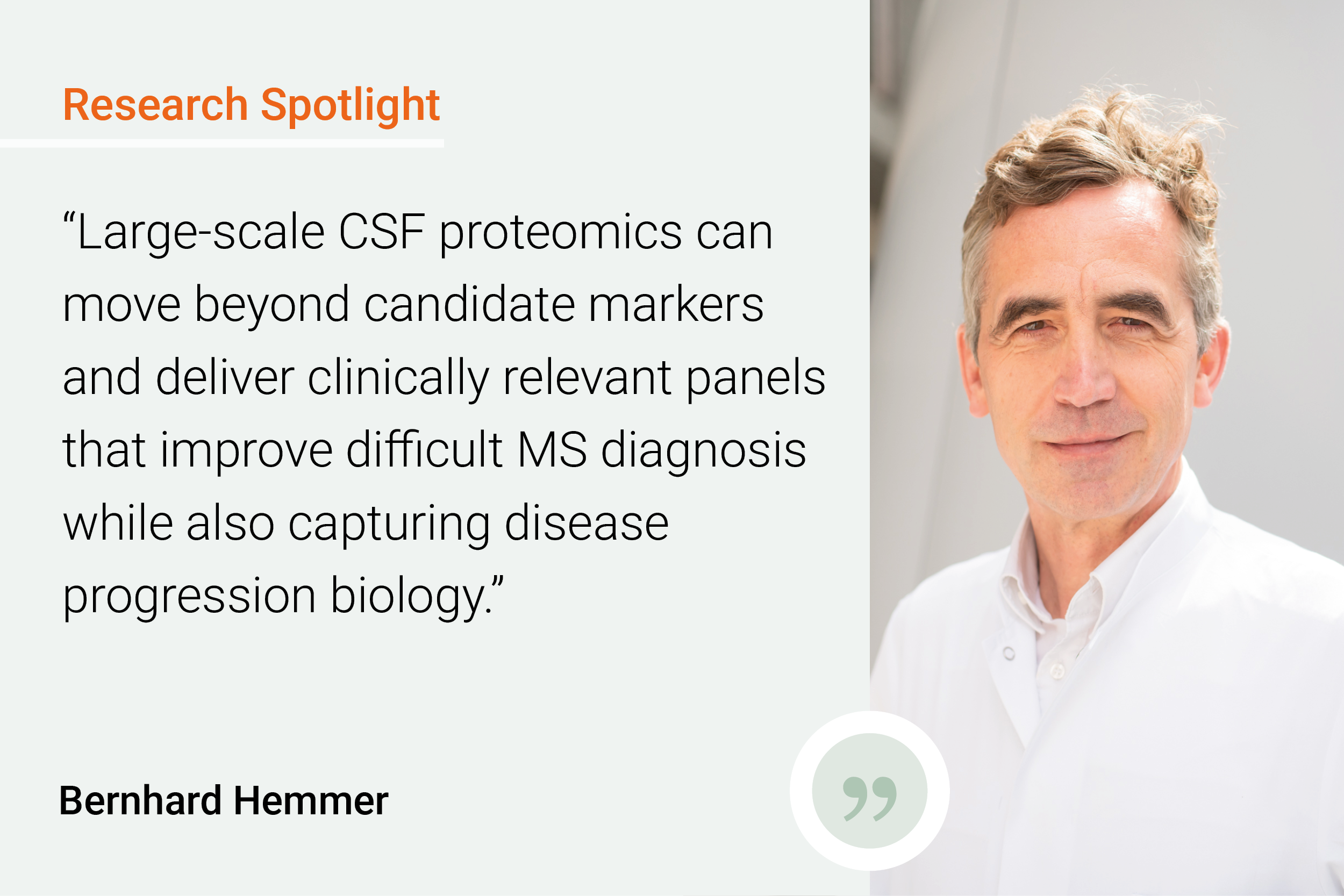
    This study brought together large-scale proteomics, computational biology, and clinical neurology within the Munich systems-neurology environment. SyNergy members Fabian J. Theis contributed computational supervision and data-analysis expertise, while Bernhard Hemmer co-led the study’s clinical and translational MS focus, including cohort design and interpretation. Their collaboration helped connect biomarker discovery with clinically meaningful validation.

    Participating Universities
     LMU logo in white
     TUM logo in white
    Partner Institutions
     Logo DZNE in white
    Helmholtz Munich logo in white 
     Logo Max Planck Gesellschaft 

    SyNergy is funded by the Deutsche Forschungsgemeinschaft (German Research Foundation) within the framework of the German Excellence Strategy (EXC 2145 SyNergy – ID 390857198). The Excellence Strategy promotes outstanding research at German universities. 

    Contact

    Munich Cluster for Systems Neurology (SyNergy)

    Feodor-Lynen-Str. 17
    81377 Munich
    +49 (0)89 4400-46497
    yüubgyJbcјuipxј#vfWulYyz/mi
    Editor login
    Imprint | Data-Safety | Accessibility