The challenge
ALS is a fatal neurodegenerative disease marked by major biological heterogeneity, which makes diagnosis, prognosis, and treatment development difficult. Several chitinases, especially CHIT1, CHI3L1, and CHI3L2, are elevated in cerebrospinal fluid and have been linked to disease severity. However, it has remained unresolved which cell types actually produce these molecules in the central nervous system, how their expression changes during disease, and whether they provide information beyond established markers such as neurofilament proteins. Without this knowledge, it is difficult to determine whether chitinases mainly reflect inflammation, neuronal injury, or a combination of both. Clarifying their cellular sources is therefore essential for understanding disease mechanisms and for improving biomarker-guided clinical studies in ALS.
Our approach
The study combined cerebrospinal fluid biomarker analyses with transcriptomic and histopathological analyses across post-mortem human tissue, three familial ALS mouse models, and cultured neurons. Using single-nucleus RNA sequencing, immunostaining, and quantitative biomarker comparisons, we mapped where different chitinase isoforms are expressed under physiological conditions and how this pattern changes in ALS.
Our findings
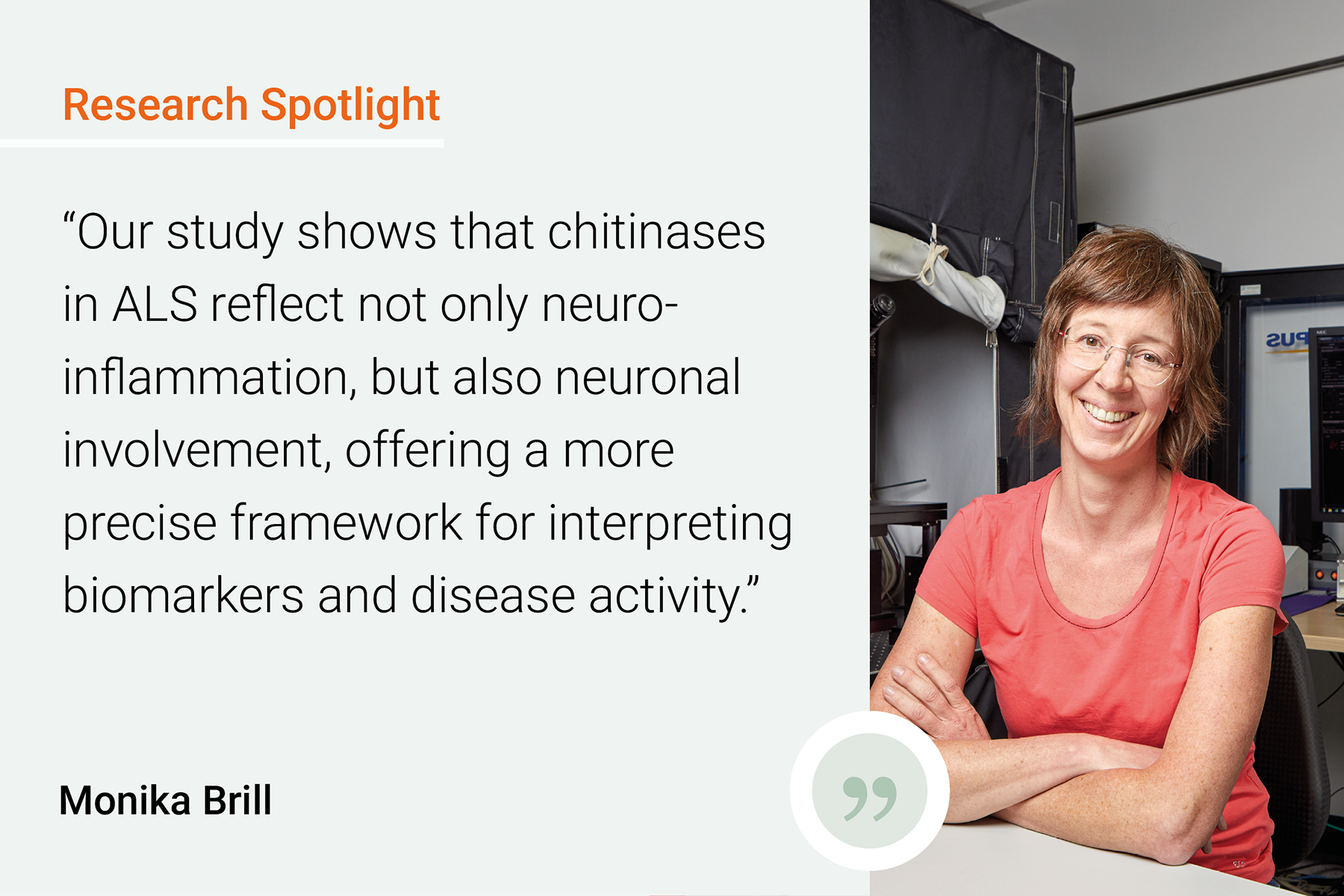
We found that neurons are a major and previously underappreciated source of chitinases in both mouse and human brain tissue. Under physiological conditions, CHI3L1 is broadly expressed and more abundant across several central nervous system cell types, whereas CHIT1 is enriched in neurons, establishing neurons as a major constitutive source of this canonical “microglial” biomarker. In symptomatic ALS mouse models, CHI3L1 becomes upregulated predominantly in astroglia and microglia, while CHIT1 increases in both neurons and microglia, revealing distinct, isoform specific response patterns to neurodegeneration. In the clinical cohort, cerebrospinal fluid CHIT1 and CHI3L2 best discriminated ALS from non ALS controls, whereas CHI3L1 levels showed closer association with disease severity, indicating complementary diagnostic and staging value of individual isoforms. Together, the data suggest that chitinases capture aspects of both neuroinflammation and neuronal damage, rather than inflammation alone.
The implications
These results demonstrate that elevated chitinases in biofluids reflect a composite signal from both neuronal and glial compartments, rather than a purely glial inflammation marker. Recognizing neurons as a key source of CHIT1 and defining isoform specific expression patterns across cell types and disease stages enables a more precise mechanistic interpretation of chitinase changes in ALS and other neurodegenerative disorders. This refined understanding can improve patient stratification, guide the selection and timing of anti inflammatory or neuroprotective interventions, and inform the design and readout of clinical trials that use chitinases as pharmacodynamic or prognostic biomarkers.
Creating SyNergies
The study brought together complementary expertise in neuronal cell biology, neuropathology, biomarker research, and neurodegeneration. In particular, SyNergy members Jochen Herms, Dieter Edbauer, and Monika Brill contributed to a collaborative framework that connected human tissue analysis, experimental ALS models, and molecular profiling across systems. This integrative SyNergy-style approach made it possible to link cellular chitinase expression directly to biomarker behavior in ALS.