This is a summary of Pürner, M. Hormozi, D. Weiß, M. T. Barbe, H. Jergas, T. Prell, E. Gülke, M. Pötter-Nerger, B. Falkenburger, (…) P. Lingor. „Nationwide Retrospective Analysis of Combinations of Advanced Therapies in Patients With Parkinson Disease“ (2023). DOI: 10.1212/WNL.0000000000207858, which appeared in Neurology.
The challenge
Parkinson's disease is the world’s second-most common neurodegenerative disease after Alzheimer's. So far, it has proved incurable. As the disease progresses and tablets no longer provide relief, invasive treatments are used, such as deep brain stimulation or drug application via pumps. However, these advanced treatments do not always achieve the desired results, may have side effects or lose effectiveness over time. In this situation, the conclusion is often reached that all options are exhausted – and physicians and patients are reluctant to try a different invasive treatment or combine the current treatment with a second method. We wanted to evaluate the effect of changing treatment in these situations.
Our approach
We collected data from 22 treatment centers all over Germany in the Competence Network Parkinson (Kompetenznetz Parkinson, KNP) covering the period from 2005 to 2021. Among the approximately 11,000 people undergoing advanced treatments at those centers during the studied period, we identified 116 persons for whom advanced treatments were replaced or combined with an additional method. Because some patients underwent even more than one change in treatment, we were able to analyze a total of 148 cases.
Our findings
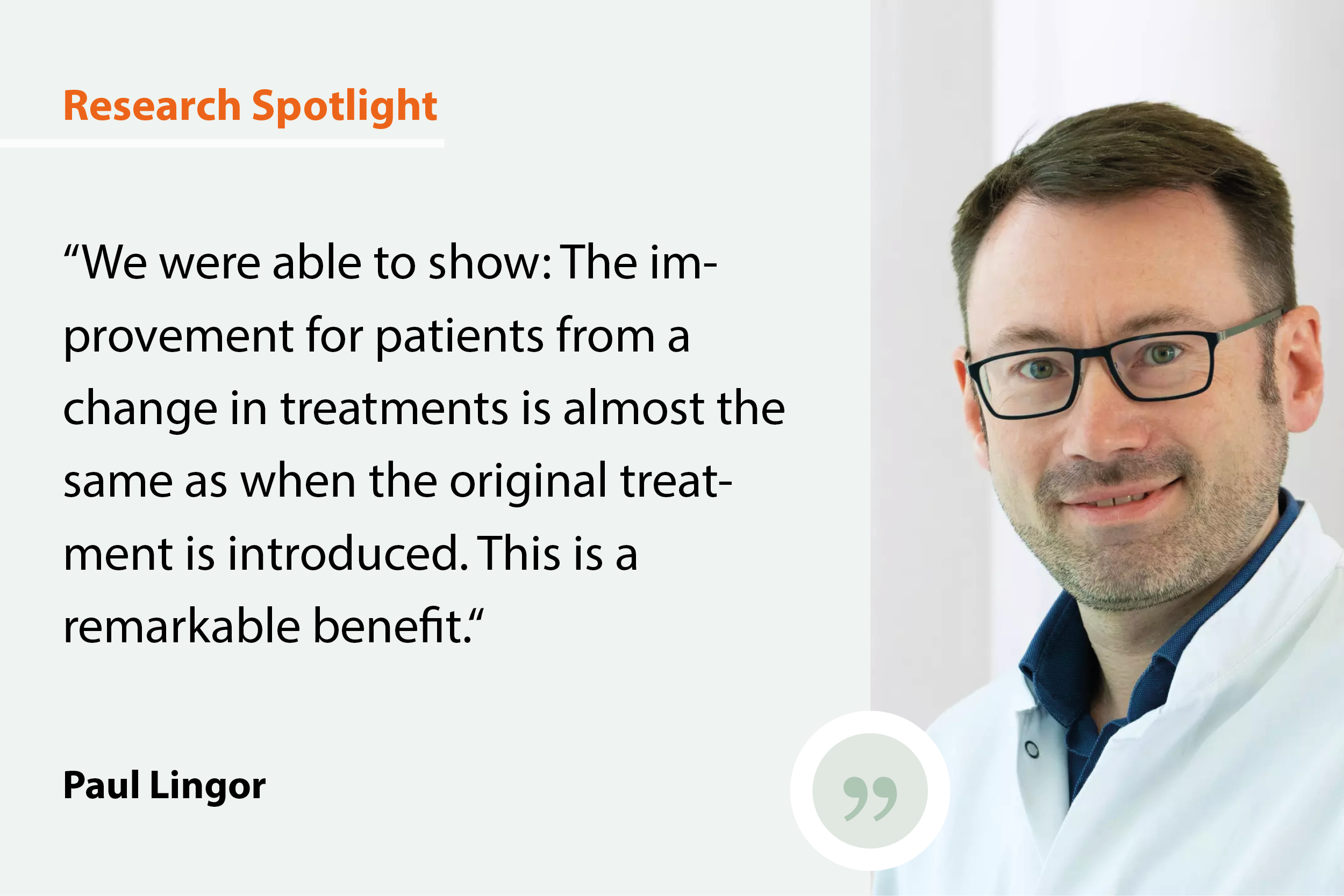
The analysis of our data shows that most of these interventions were successful. The improvement for patients from a change in treatments is almost the same as when the original treatment is introduced. Physicians and patients reported a subjective improvement that was also reflected in objective tests for motor functions.
The implications
Our results show that if an advanced treatment does not produce results or bring about the desired effects, a change in treatment should be considered. In the future, we wish to set up a Germany-wide registry including the data of all Parkinson’s patients undergoing device-based treatments to develop scientifically sound guidelines for combining advanced therapies.
Creating SyNergies
This research was conducted by Dominik Pürner, a neurologist in training, in the group of Paul Lingor. Dominik collected data from 22 treatment centers all over Germany. Only the SyNergy of all centers allowed us to draw the conclusions in this project – each center alone can only contribute a few patient cases. For the future registry, Dominik and Paul hope to use the momentum of the CAT-PD analysis and synergize even more centers for a prospective data collection.