The challenge
Amyotrophic lateral sclerosis (ALS) is a devastating neurodegenerative disease characterized by the progressive loss of motor neurons. By the time patients meet formal diagnostic criteria, substantial and irreversible motor neuron degeneration has already taken place. Identifying early disease-related features is therefore critical to enable timely therapeutic interventions and optimize clinical trial designs. While prodromal phases are well established in other neurodegenerative disorders like Alzheimer's or Parkinson's, they remain poorly characterized in ALS. Existing evidence on early symptoms has been predominantly limited to small genetic cohorts. Systematically integrating early motor complaints, non-motor changes, healthcare utilization, and metabolic trajectories within a unified framework has not yet been achieved for predominantly sporadic ALS cases.
Our approach
We conducted a large multicenter case-control study across 20 specialized clinics in Germany and Switzerland, analyzing a final cohort of 475 patients with ALS and 285 healthy controls. Participants completed a digital questionnaire detailing clinical profiles, lifestyle factors, and health changes spanning the ten years prior to symptom onset or survey completion.
Our findings
ALS patients reported a significantly higher burden of prodromal complaints, specifically localized neuromuscular impairments like muscle weakness, cramps, and arm or leg trembling. Patients also demonstrated increased neurological consultations and distinct pre-diagnostic weight loss, particularly among males. Furthermore, subgroup analyses revealed notable correlations with manual occupations and musculoskeletal disorders such as herniated discs.
The implications
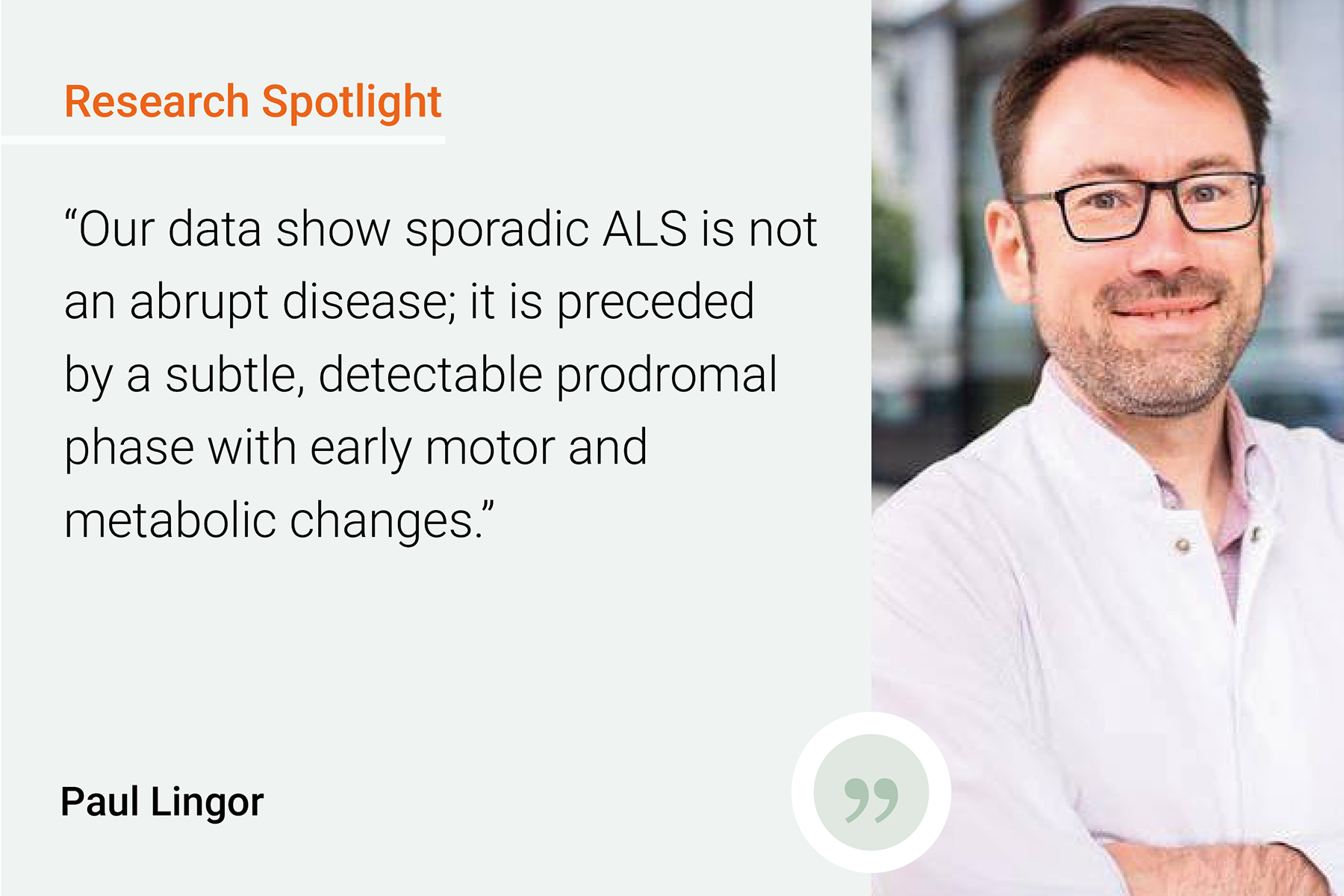
These findings support the existence of a detectable prodromal continuum in sporadic ALS, establishing early motor and metabolic changes as vital prospective markers for risk stratification.
Creating SyNergies
The collaborative study was spearheaded by our member Paul Lingor alongside an extensive network of specialized ALS clinics of the MND-NET. By combining clinical expertise with an adaptive digital framework, the team integrated environmental exposures, patient-reported symptoms, and metabolic trajectories. This systematic characterization advances joint efforts toward early-stage diagnostic biomarkers and critical therapeutic target dev