The challenge
Progressive myoclonus epilepsy type 1 (EPM1) is an inherited disorder caused by CSTB mutations, leading to neurological decline. While clinical features like impaired GABAergic inhibition are well-documented, the exact early molecular mechanisms driving network hyperexcitability remain unclear. EPM1 has not been classified as a neurodevelopmental disorder, obscuring its earliest cellular origins. It is crucial to determine if pathologically low levels of CSTB alter the extracellular environment, specifically affecting interneuron differentiation and fate specification. Understanding how these disruptions shape the delicate excitatory-inhibitory balance during brain development is essential for designing effective therapeutic strategies before the onset of irreversible brain damage.
Our approach
We used human cerebral organoids derived from EPM1 patient cell lines to model the disease. Focusing on ventrally patterned organoids, we analyzed early molecular mechanisms using single-cell RNA sequencing and mass spectrometry. We also performed electrophysiological tracking, proteomics profiling, and live imaging of extracellular vesicle dynamics.
Our findings
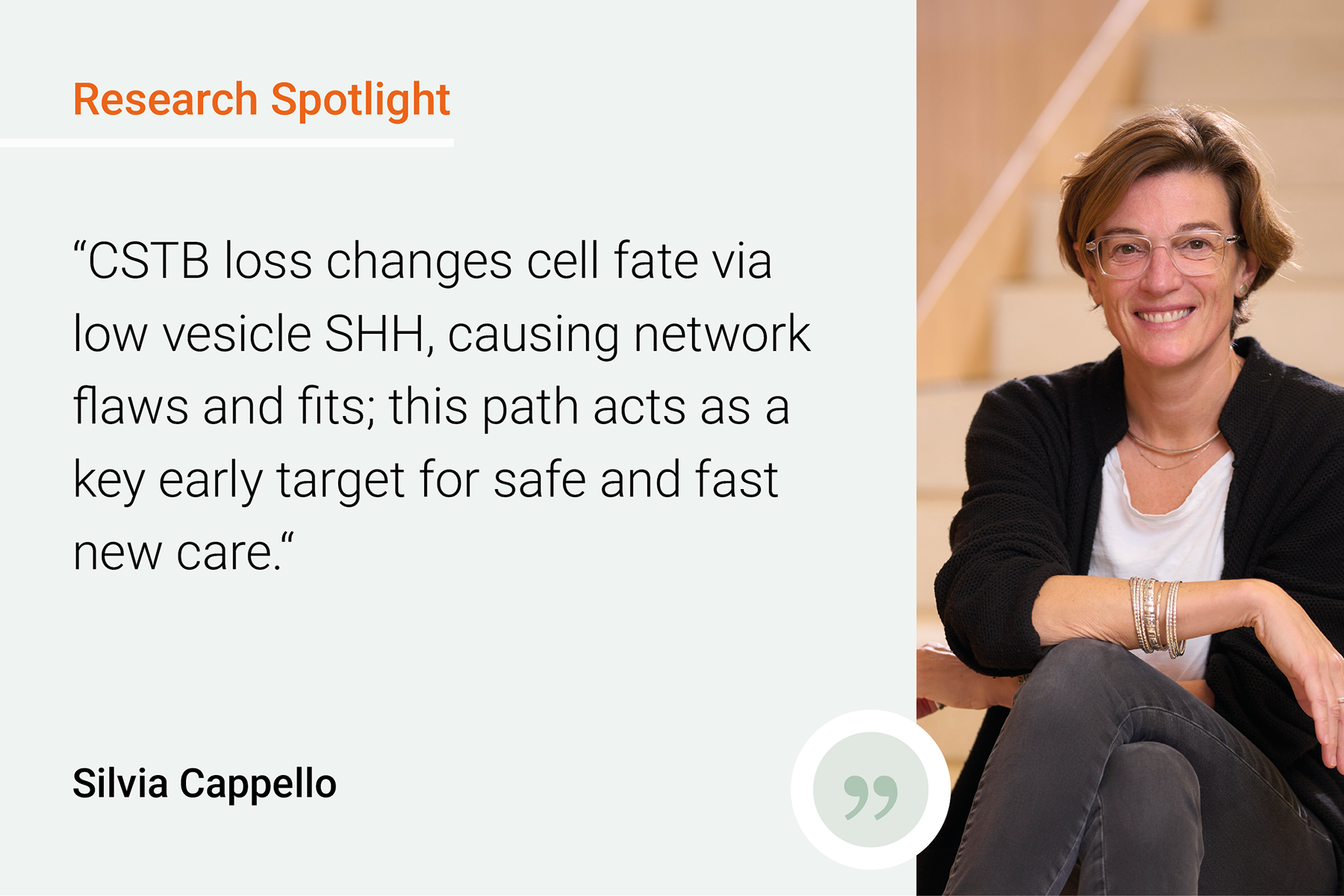
We found that EPM1 organoids exhibit heightened electrophysiological activity and an altered excitatory-inhibitory balance. Ventral progenitors undergo an abnormal specification pathway, down-regulating ventral determinants and shifting toward dorsal neuron identities. Mechanistically, CSTB deficiency impairs extracellular vesicle biogenesis and secretion dynamics. This defect depletes Sonic Hedgehog within vesicles, causing a collapse of the ventral signaling niche that drives the lineage misspecification, which can be reversed by exogenous Sonic Hedgehog treatment.
The implications
Our findings establish CSTB as a vital safeguard of ventral patterning via vesicle signaling. This identifies the CSTB-SHH-EV axis as a promising therapeutic target to rescue network imbalances early in development.
Creating SyNergies
The study was led by SyNergy member Silvia Cappello and involved strong international collaborations. By combining state-of-the-art human cerebral organoid models with advanced single-cell transcriptomics and vesicle proteomics, the team successfully uncovered a novel non-cell-autonomous mechanism. This work heavily relied on cross-disciplinary expertise to link early protein trafficking defects with the long-term circuit abnormalities seen in EPM1 epilepsy.