This is a summary of Ancău, M., Tanti, G.K., Butenschoen, V.M.i et al. et al. Validating a minipig model of reversible cerebral demyelination using human diagnostic modalities and electron microscopy. Which appeared in eBioMedicine, Volume 100, 104982
The challenge
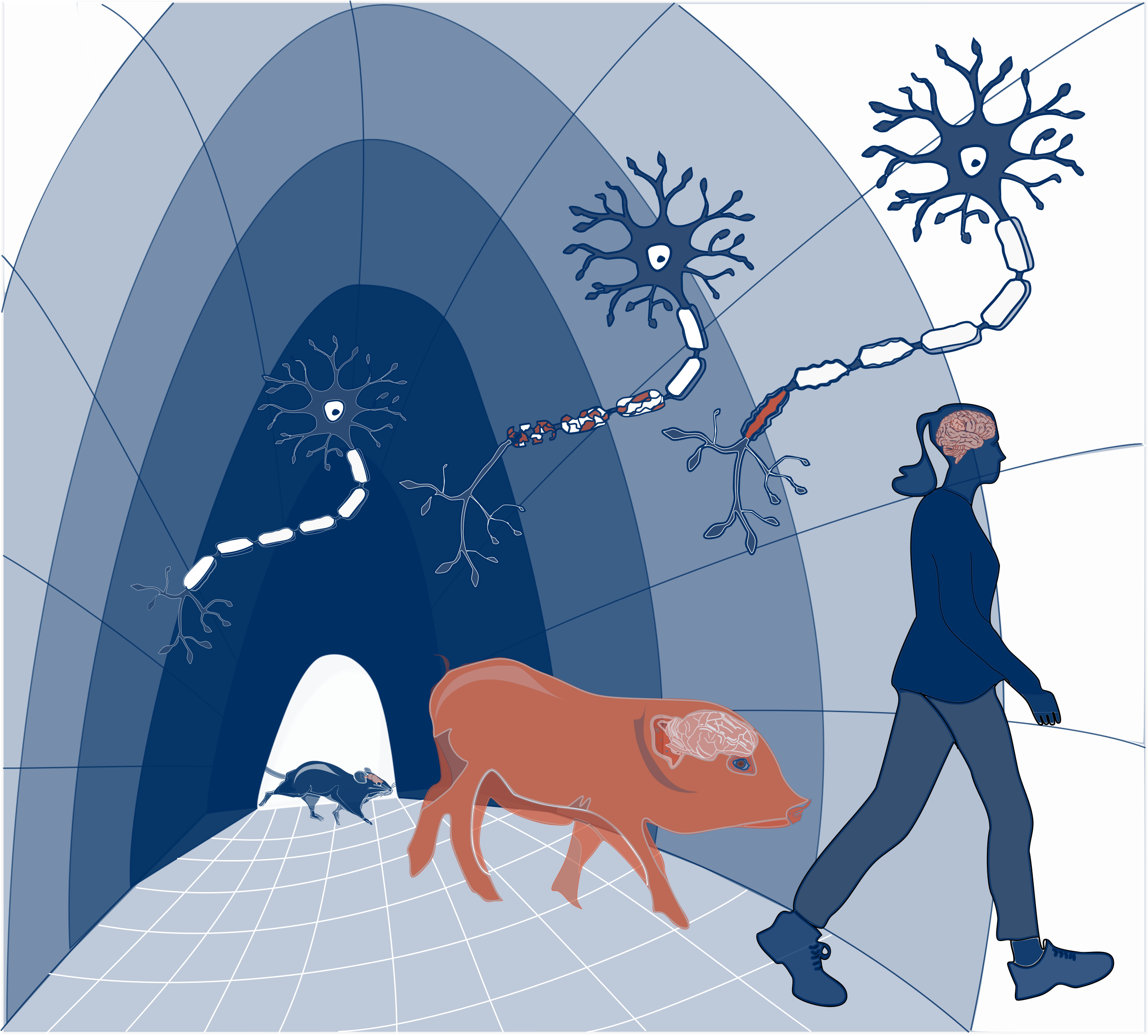
Inflammatory demyelinating diseases, such as multiple sclerosis (MS) or neuromyelitis optica, affect more than 2.5 million people worldwide. Patients typically receive magnetic resonance imaging (MRI) to assess lesions in the brain and spinal cord. However, we still need to fully understand which MRI signatures relate to which histological stage of lesion evolution. In the lab, studying lesion evolution in rodent models is challenging because the low white matter of the brain limits validity, and using neuroimaging tools is challenging due to their small brain sizes. Moreover, there are genomic and proteomic differences between rodents and humans. Therefore, to balance ethical considerations with the need for a larger brain model, we opted for the minipig as a species, allowing us to use the same diagnostic protocols and devices as in human clinical settings. Minipigs have a similar white-to-grey matter ratio (∼60:40) and are neuroanatomically, genomically, and proteomically more similar to humans than rodents.
Our approach
To systematically and reliably inject demyelinating lesions in the central nervous system of minipigs, we used computer-assisted navigation and convection-enhanced delivery. We developed a bespoke electromagnetic tracking system for our computer-assisted navigation. It is fully compatible with bendable instruments and inherent minipig anatomical challenges and can be translated to human neurosurgery. Overall, we tracked the lesions' development in the pig brain using MRI and positron emission tomography scanners used in clinical routine for MS patients. Subsequently, we also used electron microscopy to compare the tissue to human patients' tissue. We characterized different disease stages, reflecting successive stages of de- and remyelination.
Our findings
Our MiniSWINE method successfully models the disease progression of de- and remyelination and captures characteristics observed in human patients. We observed that the process of de- and remyelination was slower compared to studies with rodent models. We also found a degree of secondary axonal pathology. Both aspects suggest that our model better reflects what happens in humans compared to studies done with mice.
The implications
MiniSWINE can be a platform for developing diagnostic procedures and discovering new imaging biomarkers and therapeutic interventions. The model helps to bridge the gap between rodent models and human diseases of the central nervous system. Our new injection technique could also improve surgical procedures in humans.
Creating SyNergies
This study was led by Bernhard Hemmer and included SyNergy members Thomas Misgeld and Martina Schifferer.